

Understanding the Equine Topline: Building the Foundation for Performance and Longevity
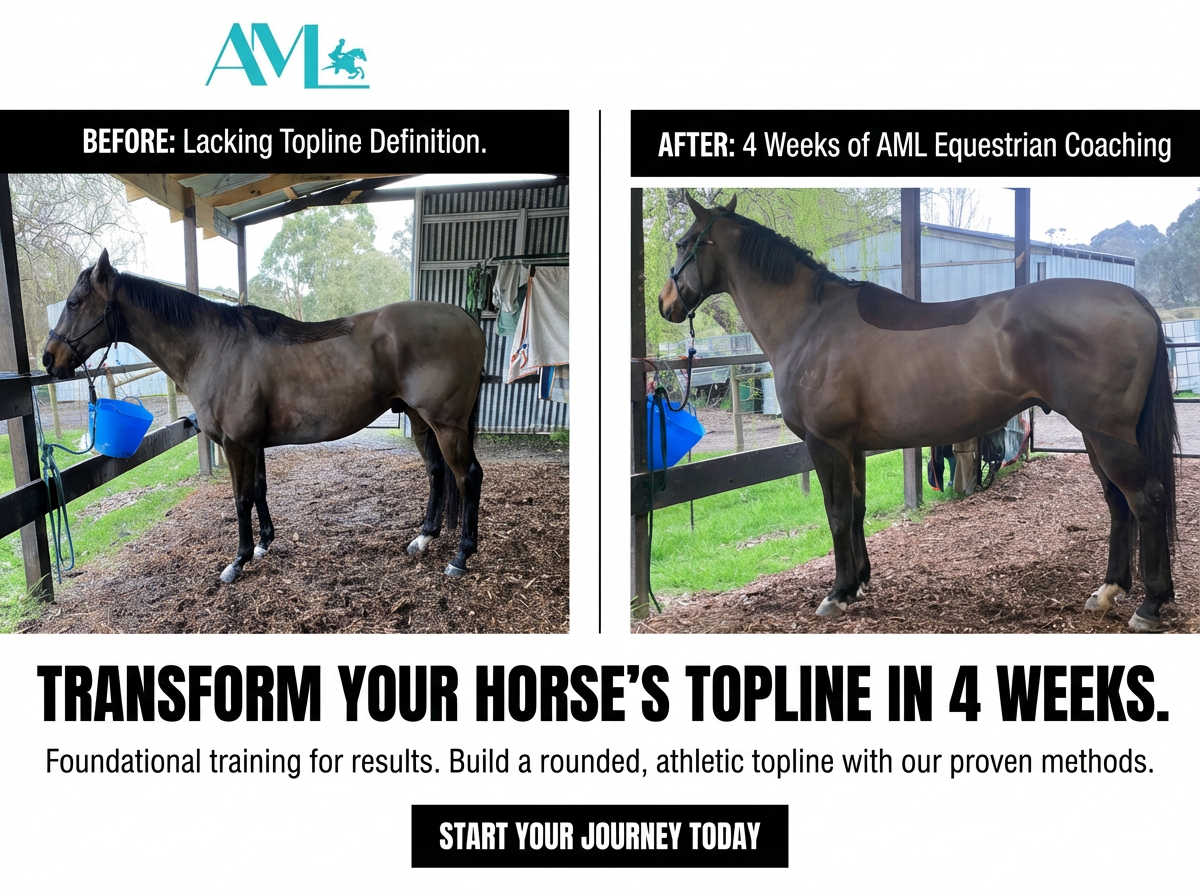
“Thomas” - clients horse who came to me for training after showing unwanted behavioural issues. We had him re-shod by a corrective farrier which then allowed Thomas more comfort and the ability to undergo a strategic and tailored training program to gain these results in just four weeks.
Introduction
As equestrian coaches and riders, we often hear the term "topline" discussed in relation to horse health and performance. But what exactly is the topline, and why should it matter to anyone working with horses? Whether you're training a young prospect, rehabilitating an injured horse, or competing at the highest levels, understanding and developing a strong topline is fundamental to creating a sound, capable athlete.
What is the Topline?
The topline refers to the muscular structure along the top of the horse's body—specifically, the muscles running from the poll (top of the head) down the neck, across the back, and through the hindquarters to the tail. The primary muscles that make up the topline include:
Neck muscles (particularly the cervical ligament and neck extensors)
Trapezius and rhomboid muscles (shoulder region)
Longissimus dorsi (the longest muscle running along the spine)
Multifidus muscles (deep stabilizer muscles along the spine)
Hindquarter muscles (gluteus medius, gluteus maximus, and other hip extensors)
When we refer to a horse having a "good topline," we're describing a horse with well-developed, toned muscles in these areas that create a smooth, rounded appearance from poll to tail.
The Topline's Role in the Musculoskeletal System
The topline doesn't exist in isolation—it's intricately connected to the entire musculoskeletal system of the horse. Understanding these connections is crucial:
1. Spinal Support and Stability The topline muscles act as critical stabilizers for the vertebral column. A strong topline provides support and protection for the spine, reducing stress on the joints and ligaments. Without adequate topline development, the spine becomes vulnerable to strain, leading to potential injuries and chronic pain.
2. Connection to the Core The topline works in conjunction with the abdominal muscles to create a functional core. When the topline is weak, the horse compensates by relying more heavily on ligamentous support (passive structures) rather than muscular support (active structures). This is inherently unstable and unsustainable.
3. Influence on Limb Biomechanics A well-developed topline directly impacts how a horse moves. When the topline is strong, the horse can:
Engage the hindquarters more effectively
Achieve better shoulder mobility
Maintain proper spinal alignment
Generate more power from behind
Move with greater efficiency and less concussive force
4. Impact on the Neck and Forehand The neck muscles are the bridge between the hindquarters and the forehand. A weak or underdeveloped topline in the neck region often leads to:
Horses that lean on the forehand
Difficulty achieving self-carriage
Tension in the poll and jaw
Reduced ability to collect
Why Building Topline Matters: General Population
For all horses—whether they're pleasure mounts, trail horses, or breeding stock—a healthy topline is essential for:
Longevity and Soundness Horses with strong toplines experience fewer injuries and joint problems. The muscular support reduces stress on bones, joints, and ligaments, extending the working life of the horse and reducing veterinary bills.
Comfort and Rideability A horse with a developed topline moves more comfortably and is generally easier and more pleasant to ride. The horse isn't fighting against pain or instability, making training more effective and enjoyable for both horse and rider.
Posture and Conformation While we can't change a horse's skeletal conformation, muscular development can significantly improve how a horse carries itself. A strong topline helps horses maintain better posture, which improves their overall appearance and function.
Why Building Topline is Critical for Performance Horses
For performance horses—whether competing in dressage, jumping, eventing, western disciplines, or any other sport—topline development becomes non-negotiable:
1. Power and Athletic Performance Performance horses must generate significant power and athleticism. The topline provides the foundation for:
Explosive power from the hindquarters
Sustained collection and self-carriage
Smooth, efficient transitions between gaits
The ability to handle the demands of advanced training
2. Injury Prevention High-level training places enormous demands on the horse's body. A weak topline means the horse is working with an unstable foundation, which exponentially increases injury risk. Topline development is preventative medicine.
3. Carrying Weight and Collection Performance horses must carry a rider's weight while maintaining balance and performing complex movements. Without a strong topline, the horse cannot:
Achieve true collection
Shift weight to the hindquarters
Maintain the muscular engagement required for advanced movements
Stay sound under the demands of training
4. Responsiveness and Rideability A horse with a well-developed topline is more responsive, more balanced, and easier to train. The rider has a more stable platform to work from, and the horse can execute movements with greater precision and ease.
5. Recovery and Durability Horses with strong toplines recover better from training, experience less muscle soreness, and have greater durability throughout their competitive careers.
How to Build and Maintain a Healthy Topline
Building topline is a progressive process that requires:
Correct groundwork and pole exercises to develop awareness and engagement
Progressive, systematic training that builds strength gradually
Proper rider position and balance (the rider's position significantly impacts topline development)
Varied training that engages different muscle groups
Adequate recovery and nutrition to support muscle development
Regular assessment to ensure correct development
Conclusion
The topline is far more than an aesthetic feature—it's the foundation of equine athletic performance and longevity. Whether you're working with a pleasure horse or an elite performance athlete, investing in topline development is one of the most impactful decisions you can make for your horse's health, soundness, and career longevity.
As coaches and riders, understanding the importance of topline and implementing systematic training methods to develop it is a hallmark of quality horsemanship.